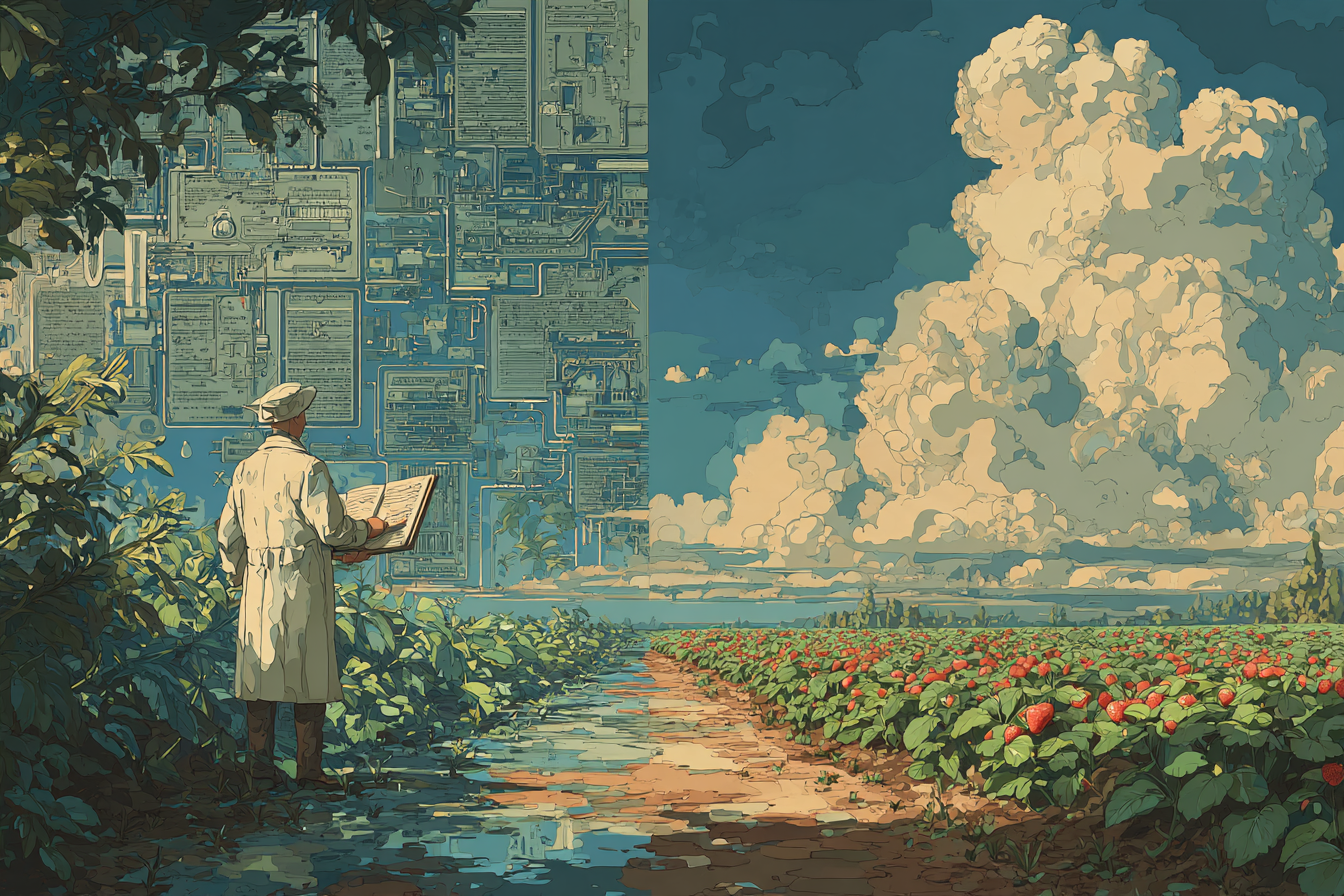
TL;DR: Complicated problems have answers if you read enough rules. Complex problems change while you are reading. Most of what Moative automates in healthcare is the first kind, which involves deep understanding of layers of perverse web of rules and exceptions. We encounter the second kind in energy and agriculture, through small experiments, keeping expectations low but anticipation high. The prize is sweet.
If you are in the business of complications, you'd buy AI differently than if you are optimizing a complex system. We have ideas. Read on.
A jigsaw has a thousand pieces
and one picture on the box.
A sandcastle has a plan
until the tide reads it.
Healthcare billing is a jigsaw.
Ten thousand codes, four hundred payers,
rules written by people
who were never going to follow them.
It is miserable. It is also finite.
The vendor calls it complex.
Complex costs more per seat.
The buyer nods,
because nobody wants to hear
that their life's tangle fits in a context window.
Meanwhile a strawberry
gets thirty minutes of unplanned rain
and turns out slightly sweeter,
or doesn't.
There are decks for this too.
The strawberry has not read them.
The jigsaw and the sandcastle. Rick Nason's It's Not Complicated draws the line. A complicated system is predictable given enough information. Describe every part and you have described the whole, and you can write a script to run it. A complex system adapts, organises itself, and produces outcomes nobody ordered.
The billing. Hundreds of processes, codes, claim formats and payer rules, some of which seem designed to produce the universal longing to open a cafe and never look at a monitor again. All of it can be learned by a sufficiently smart brain, and smart brains are now sold by the token. In fairness, one part does adapt: payers change how they deny claims in response to whatever providers do. That part is complex. It is also the part missing from every product demo. But the payer will not adapt in million different ways. Even when complexity is present, it is low and solvable.
The label. Both words get bent to shape by an actor, the vendor who decides which word applies. Observers with something to sell tend to round up. "Complex" supports a proprietary model, a research team and a premium. "Complicated" supports a statement of work. Buyers go along with it, because a complex business gets to have a moat and a complicated one gets a vendor. In complicated work, compute does the solving and the buyer's data does the differentiating. Everything else is available from several suppliers at falling prices. The winners get measured on execution, which is a harder thing to raise a round on.
The strawberry. What a lake, a westerly wind and humid air do to a turbine's output just before it pours. What half an hour of rain does to sugar. Plants grown to synthesise botanical compounds, where the plant has the final say. Specific AI labs are working on chemistry, drug synthesis and weather, and the foundational world model companies keep removing limits that help all of them.
The water tank. As AI gets smarter problems keep getting demoted from complex to complicated. Weather is partway through its demotion. In ten years intelligence is the tank on the roof. It is there. Some tenants use more of it than others. Nobody thinks about it when they flush. Attention moves on to other things, such as food designed for one person's genetics.
The cafe. All of us will open cafes at some point, really or metaphorically. Some of us will solve complicated problems faster and better, show that execution is all that matters, and bring home a trophy and a plan for the cafe. A few oddballs in us are going to shrug and solve complex problems moving from failure to failure, and eventually put a dent on the universe and then go have a coffee whose beans were custom-grown for our genetics.