TL;DR
- The technology is compounding fast while your organization's ability to absorb it still runs on human cadence: skills, trust, policy, process.
- A workforce is not a commodity being substituted by AI. It is a porous substrate through which the benefits have to pass. That is osmosis rather than substitution.
- Budget question for the coming year: how much AI cost will be offset by reducing headcount? The short answer is not much, and 2026 is not that year.
- Map productivity gain against displacement gain for every workflow, before the deployment rather than after it.

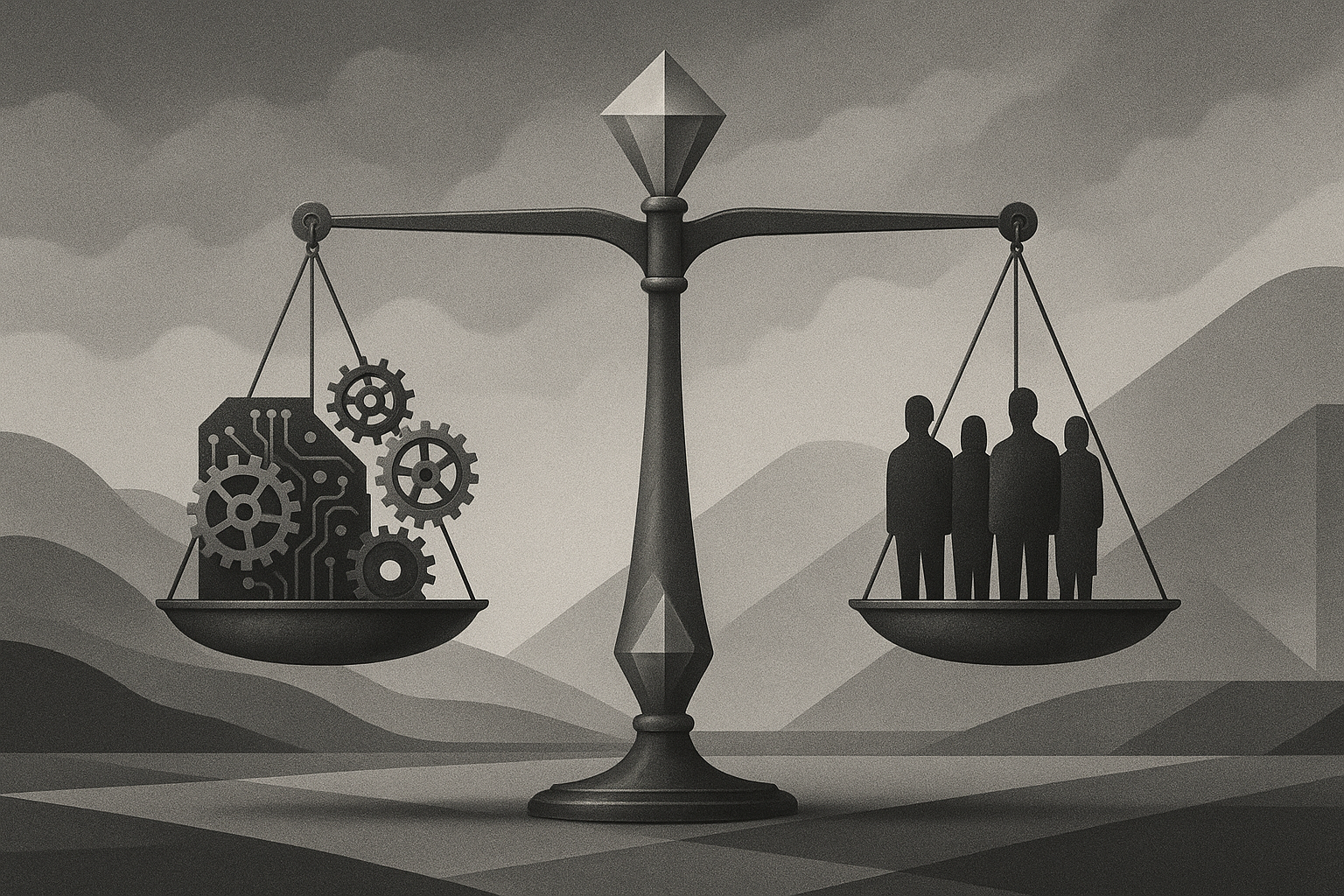
Here’s the uncomfortable midpoint we’ve reached with enterprise AI: the tech is compounding fast, while your organization’s ability to absorb it still runs on human cadence – skills, trust, policy, and process. An enterprise's workforce is not a commodity that is being substituted by AI but a porous substrate through which AI's benefits have to be transferred. It's osmosis, not substitution.
Understanding AI’s impact in terms of workforce redesign
McKinsey’s modeling points that by 2030, up to 30% of current hours could be automated in a midpoint adoption case, driving significant occupational shifts and a premium on tech + social skills; productivity upside depends on how quickly enterprises redeploy and upskill, not just how quickly they deploy models.
As initial enterprise deployments show, large portions of the workforce will be re-tasked rather than replaced. Displacement will come in the form of lack of replacements or entry-level hires. The enterprise still has to have a framework for how to view AI rollouts in the context of the org functions, roles, and how they will have to be re-designed.
Let’s take co-pilots vs. auto-pilots. We don’t hear these arguments any longer. Most enterprises have defaulted to some kind of co-pilot mechanism, with certain pockets of autonomous decisions or communications run by agents. Moative, in fact, launched a fully autonomous voice agent that communicates as front-line support staff would, but with a switch that flips to human involvement should edge cases come up.
So how does an enterprise draw up AI vs. human budgets for 2026?
In plain words, what cost of AI deployments will be offset by gains from retrenching the human workforce? The short answer is ‘not much.’ AI is solving productivity and customer satisfaction problems. We are not yet doing away with large swathes of the workforce. We are close but 2026 isn’t that year. But as the gains start showing and the equilibrium between autonomous workflows and assisted-workflows are understood, we will know where we need people and where we don’t anymore.
So how does an enterprise assess the impact of AI deployments on the workforce?
Start with task-level analysis to separate “automation-assist” from “automation-replace,” then publish internal groupings: which tasks move into supervision/exception-handling; which service roles will be fully automated; which new roles emerge to manage data, context model maintenance, etc.
An explicit ‘Productivity gain’ vs. ‘Displacement gain’ against each workflow has to be mapped for each AI initiative - to know what the AI-Human balance for those workflows will look like, at the end of the deployment. A parallel process of retraining, re-allocation, or displacement assistance should be initiated by the organization. In most enterprises today, where we either have pilots or first set of deployments, there is no such framework to define, audit, and to set the course of the automation-human balance.
What does an AI Pilot with a workforce optimization plan look like?
Stand up a cross-functional Workforce + AI Council (HR, Legal, Ops, IT, Works Council/union where applicable). Its first deliverables:
(a) a task-exposure map of your top five job families, tied to skills implications;
(b) a catalog of ‘new skills’ that need to be aligned with the job families based on the intensity of the task exposure and what that means for each of those job families.
Launch pilots with explicit human-in-the-loop checkpoints (Ex: customer email drafting with mandated human send; AP triage with confidence thresholds and auto-escalation). Instrument for cycle time, error rates, and override reasons. Document the human involvement in time and skill-level dimensions and map to the skill levels of the workforce needed.
A pilot’s goal is not to make AI fully replace humans but to understand what the optimum balance is so that the organization can be designed around the achievable optimum. The related discipline of measuring the right thing is in Understand AI's value for an enterprise.
Graduating from pilots: Artifact your way to clarity
Launch an annual workforce-AI report: Document exposure, redeployment, training hours per employee, productivity deltas by process, incident/override stats, and remediation. In strong regulatory markets these may become mandatory. In market-driven scenarios too, knowing what human-AI optimum looks across various functions and workflows helps the decision makers to allocate budgets, resources, and issue guidance with confidence.
Realistic assessment of AI’s impact on workflows and the workforce comes from explicit telemetry that measures an AI pilot’s outcomes in the frame of what it does to the workforce. Measurement leads to realistic expectations on AI’s impact and a graceful, fully-prepared approach toward dealing with workforce re-alignment. Besides, it's just a strong way to signal your organization that the impact of workflow changes on the workforce is not an afterthought but central to how the AI initiatives are rolled out.
Enjoy your Sunday!
Sathish Rangarajan contributed to this article.
Where Moative fits
Moative instruments the human side of a pilot as deliberately as the technical side, because override reasons and escalation patterns tell you more about the eventual operating model than accuracy scores do. That means capturing not just whether the system was right, but what a person did when it was not, and what skill that person needed. In healthcare revenue cycle management that distinction decides whether a team ends up supervising exceptions or still doing the original job with extra steps.
Frequently asked questions
Will AI replace enterprise jobs in 2026?
Not at scale. Current deployments are solving productivity and customer satisfaction problems, and the displacement that does occur mostly appears as roles not backfilled rather than as reductions. The equilibrium between autonomous and assisted work is not yet understood well enough to plan headcount around it.
How much AI cost can be offset by reducing headcount?
Very little at present. Building a business case on displacement savings will disappoint, because the near-term returns come from throughput, consistency and customer outcomes rather than from payroll.
What is a task exposure map?
An analysis of your main job families at task level, separating work that AI assists from work AI can take over, and tying each to the skills implication. It is the input to every other workforce decision and most organizations skip it.
What is a workforce and AI council?
A cross-functional group covering HR, legal, operations, IT and employee representation, responsible for the exposure map, the new skills catalog and the governance of the human and AI balance. Its value is that the workforce question gets owned before the deployment rather than after.
How do you measure the human impact of an AI pilot?
Instrument cycle time, error rates and override reasons, and record human involvement in both time and skill-level terms. Override data in particular reveals which parts of the job actually require judgment.
What should go into an annual workforce and AI report?
Exposure by role, redeployment activity, training hours per employee, productivity differences by process, incident and override statistics, and remediation taken. In some regulated markets this will become mandatory, and it is useful regardless.