
Much of the discourse in the business of Applied AI is clogged by the chant for AI Services religion and the high priests being ‘Forward Deployed Engineers.’ There is so much one hears about it; every frontier tech company and opportunistic finance bros peddling podcasts now have an AI services company of their own. The discourse has become a doctrine.
We started Moative to build and spin out ideas in regulated industries. Inevitably, we had to do consulting. We deployed smart folks to learn the language of the industries we serve before we could investigate ideas. It’s been two years. We have seen, first-hand, new forces that are taking shape, in how software gets deployed to enterprises.
Forward-deployed Consultants (a.k.a ‘Consultants’) are important to accelerate diffusion (a.k.a ‘Adoption). But adoption of applied AI software is not neatly divided into products and services.
There is a new category that is evolving: Malleable Software.
Software built by users
Todd Saunders, who is experimenting with enabling blue collar companies to build their own tools, did an informal pool on X. Here is what caught my attention:
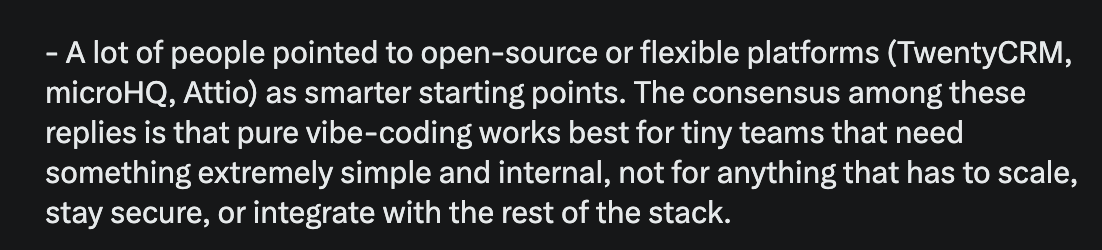
What he calls flexible platforms is what I call as ‘Malleable Software.’
A few days ago, a company called Vendo launched. They speak to software product companies. Their pitch? Let your users extend your software.
We are launching our own CRM. Our pitch is that basic features come free and extending them is when you pay a one-time fee.
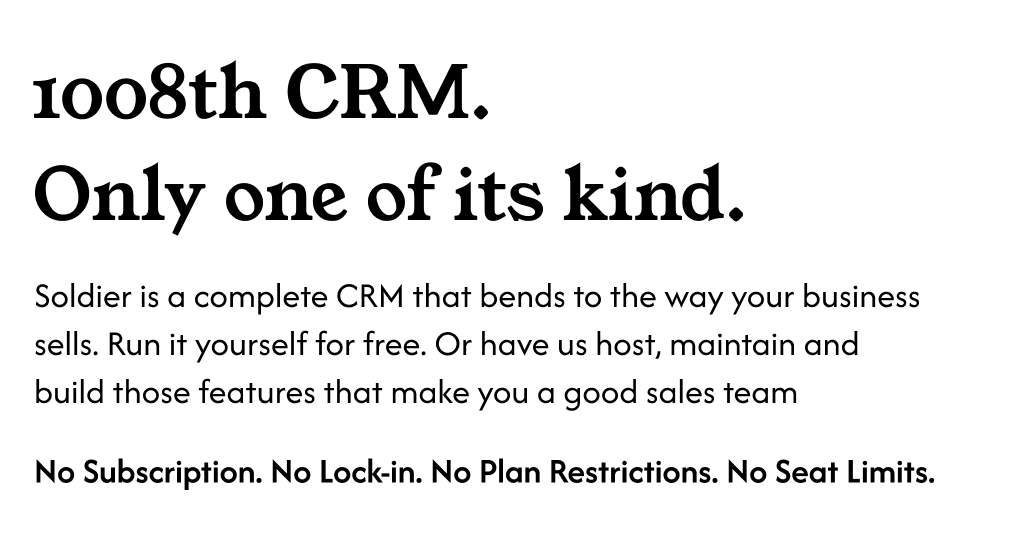
But I guess the more elegant version of this ‘extension’ of software is not custom-development. Custom development has its place in complex environments with a lot of legacy. For small and mid-sized businesses with reasonably stand-alone software systems, a base version with a harness (building foundation) and a set of lego blocks that the users themselves can use to extend the software is far more powerful, faster, and cheaper than custom development or even SaaS products.
Every software product will become extendable
Software product companies will rapidly enable harness capabilities and custom-builds on top of their platforms. It will be their answer to ‘vibe coding’ and ‘custom software development.’ This is the first good answer I have seen where I believe that software product companies can survive the AI wave, simply by being the surfboard that the users can use to take advantage of the wave.
Software companies will transform from being the pipe through which AI gets adopted by businesses to the surfboard that enables the users as they catch the right waves to surf.
Every software product company will provide a base software, a harness, a few pre-built blocks, a guardrail system of observability & security and put the roadmap of the software in the hands of its users. Consequently, software products are going to become complex. Every software company will become a platform by default. Mulit-tenant SaaS models will co-exist with multiple tenants. Self-hosted models will emerge too. We are experimenting with this approach.
The Ask
In the last few months we built a CRM, a project tracker, a HR performance management system, and an outbound email campaign automation system. If you are a small or mid-sized company that wants to extend these to fit your world, give me a shout.
We are giving away these products for fee and extend them for you for a minimal fee.