TL;DR
- A knowledge graph connects information by making relationships explicit, as nodes for data points and edges for the connections between them.
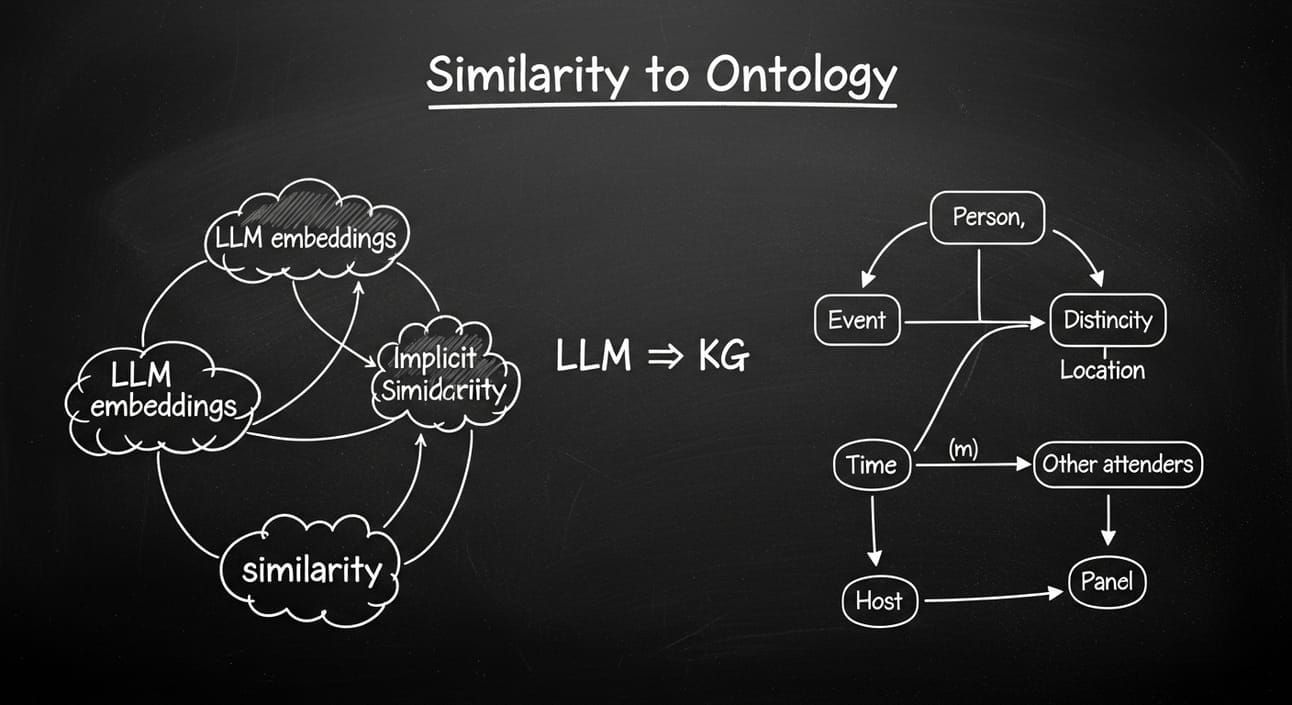
- Large language models capture relationships implicitly, through a general sense of similarity. A graph states them, using the ontology your industry already agreed on.
- That difference is what reduces hallucination and makes the output usable in your context rather than in general.
- Your organization's graph is unique to you, which is exactly why it can be a durable advantage rather than a feature anyone can buy.
What a graph actually does
A graph is an incredibly powerful tool for connecting knowledge. It does this by explicitly showing the relationships between different pieces of information, much like how humans link existing knowledge with new data. By creating "nodes" for individual data points and "edges" to define their connections, a graph provides a visual and structured representation. This allows organizations to combine internal and public data, mirroring how individuals integrate new information into their current understanding. Continuously refining these connections enables a graph to adapt and effectively leverage both private and public information, tailored to specific organizational contexts and boosting productivity.
A concrete case: pharmaceutical research
Consider a common challenge in pharmaceutical research: comparing interactions of molecules with each other and with biological entities. Existing information on these interactions is found in various public and private data sources.
Public: Academic publications, public databases, and standards on taxonomy and ontology.
Private: Databases containing proprietary information.
Pharma research organizations leverage both public and private information to query existing data on compounds and biological entities, and to compare compound properties and interactions using machine learning.
This required information is scattered across public and private sources, much like pieces of a puzzle. We utilize knowledge graphs as a structured database to integrate this disparate information, fitting the puzzle pieces together and significantly enhancing research productivity.
But do language models not already do this?
One might wonder, "Don't Large Language Models (LLMs) already implicitly link similar concepts? What do we need graphs for?"
- Explicit relationships and reduced hallucinations: LLMs implicitly capture relationships through a general idea of "similarity." Knowledge graphs, however, make these relationships explicit using prior knowledge of ontologies. This significantly reduces "hallucinations," a common error in LLMs.
- Contextual enhancement and usability: LLMs are trained on vast amounts of publicly available data. Knowledge Graphs enhance this by mapping relationships between concepts based on an organization's specific context and value creation. This helps tailor information to the organization's context, thereby improving its usability.
The mental model
Think of LLMs and Knowledge Graphs like the broad, language-based communication we have as individuals, and the underlying representation and connections between concepts that we all seemingly leverage daily. Each of us maintains a unique Knowledge Graph in our minds, that’s evolving based on private and publicly available information.
Similarly, an organization's Knowledge Graph is unique, which has the potential for significant competitive advantage. It integrates diverse data to accelerate research and enhance decision-making in various industry-specific contexts.
Look out for our future post, which will delve deeper into Knowledge Graphs, how they enhance LLMs, and their role in business value creation, along with a case study!
Vinodh Venkatesan
Where Moative fits
Moative builds the context layer before the model layer, because in regulated and technical domains the difference between a useful system and an impressive demo is whether the relationships are stated or guessed. In healthcare revenue cycle management the same principle applies to payer rules, codes and denial reasons, where an explicit structure is what keeps a model from inventing a plausible answer. The wider argument for why that context belongs to you rather than to a vendor is in Buying vs. Becoming AI.
Frequently asked questions
What is a knowledge graph?
A structured representation of information in which data points are nodes and the relationships between them are edges. It makes connections explicit and inspectable rather than implied.
How is a knowledge graph different from a large language model?
A model infers relationships from similarity across its training data. A graph states them, grounded in an agreed ontology. One is broad and probabilistic, the other is specific and checkable, and they work well together.
Do knowledge graphs reduce hallucinations?
They substantially reduce them, because the model no longer has to guess at a relationship that the graph can assert. This matters most in domains where a confident wrong answer carries real cost.
Why do knowledge graphs matter for research organizations?
Because the relevant information is split across public literature, public databases and proprietary sources. The graph is what assembles those pieces into something queryable, which is where the productivity gain comes from.
Can a knowledge graph be a competitive advantage?
Yes, because it encodes your organization's own context and value creation, which no vendor can replicate from public data. That is the part that does not commoditize as models get cheaper.
Where do you start building one?
With the ontology your industry already uses, then the private data that the public standards do not cover, then the specific decisions you want the system to support. Starting from the decision rather than the data keeps the graph from growing without purpose.